
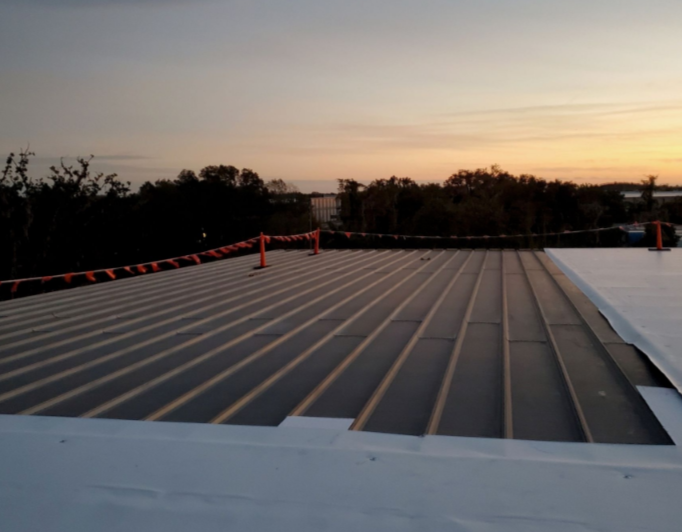
Sequencing, racking choice, flashing, and the manufacturer sign-off an owner needs before a solar installer sets foot on a low-slope roof.
Rooftop solar on a commercial building looks like a straightforward addition on paper: mount panels, run conduit, connect to the grid. On a low-slope membrane roof, it’s actually a second construction project layered on top of the first one, and the sequencing question decides whether that second project protects the investment underneath it or quietly damages it.
The mistake shows up on buildings where the roof and the solar array were planned independently: a facilities team excited about a twenty-five-year solar array bolts it onto a membrane with six years of service life left. The array outlives the roof by nearly two decades, and removing and reinstalling a working solar system to replace the roof underneath it costs far more than doing the sequencing correctly the first time.
Roof age versus array life: the sequencing question that decides the budget
A commercial roof membrane typically has a defined remaining service life, and a solar array is typically financed or planned against a much longer horizon of fifteen to twenty-five years depending on the system. Installing new solar over a roof that’s already well into its service life sets up a mismatch: the roof will need replacement while the array is still fully functional, and removing a working array to access the membrane underneath adds a significant, avoidable cost to that future re-roof.
The fix is sequencing, not avoidance. A roof condition assessment before a solar proposal moves forward tells an owner whether the existing membrane has enough remaining life to outlast the array’s typical payback period, or whether re-roofing first, even ahead of schedule, is the cheaper path over the array’s full lifespan. Solar installers are rarely positioned to make that call. A roofing contractor evaluating remaining membrane life is.
Ballasted versus mechanically attached racking, and what each does to the membrane
Ballasted racking systems rest on the roof surface, held in place by weight, typically concrete blocks or paver trays, rather than penetrations through the membrane. This avoids adding new penetrations, but it adds substantial dead load that the roof structure needs to be engineered to carry, and it changes how wind moves across the roof surface, which affects uplift calculations at the roof’s edges and corners.
Mechanically attached racking penetrates the membrane at each mounting point, which reduces structural load concerns but multiplies the number of places where the roof can leak if flashing isn’t done correctly. Neither approach is universally better. The right choice depends on the deck’s load capacity, the membrane type, the roof’s age, and the wind exposure of the specific building, and it should be an engineering decision made jointly with input from whoever holds the roofing warranty, not a default the solar installer arrives with.
Every penetration needs to be flashed like a roof penetration, because it is one
A solar racking penetration is, structurally speaking, no different from a pipe penetration or an equipment curb: it’s a hole in the membrane that needs proper flashing to stay watertight. The difference is volume. A single rooftop unit might create four or five penetrations. A mechanically attached solar array across a large commercial roof can create dozens or hundreds, each one a potential leak point if the flashing detail isn’t executed to the same standard as the rest of the roof.
This is where solar installers who don’t specialize in roofing create long-term problems. A properly flashed penetration uses compatible materials, correct sealant chemistry for the membrane type, and a detail that sheds water rather than collecting it. A rushed penetration, sealed with whatever caulk was on the truck, can hold for a season or two before it starts leaking, by which point the original installer has moved on to the next project.
Who holds the warranty once a second trade touches the roof
Most commercial roofing manufacturers issue warranties that include conditions about who can work on the roof after installation, and unauthorized penetrations or modifications by an outside trade can void that warranty entirely, regardless of whether the solar work itself caused a problem. This is the detail that gets missed most often: the owner assumes the roofing warranty and the solar installation are separate concerns, when in practice the roofing manufacturer’s warranty terms often govern what’s allowed to happen to their membrane after the fact.
- Get the roofing manufacturer’s written sign-off on the specific racking system and attachment method before solar installation begins
- Confirm in writing which party, roofer or solar installer, is responsible for flashing at each penetration
- Keep documentation of the approved racking layout in case a warranty claim needs to reference it later
- Ask whether the manufacturer requires their own certified installer to perform or inspect the penetration work
Getting that sign-off before the racking order is placed, not after, is the difference between a solar project that preserves the roofing warranty and one that quietly voids it the day the first lag bolt goes through the membrane.
Access and maintenance paths once panels cover the field
Once an array covers a significant portion of the roof field, routine roof maintenance changes. Inspectors need a clear path to check drains, seams, and flashing details without walking across panel surfaces or racking rails not designed to bear foot traffic. Snow removal, gutter clearing, and general housekeeping all need a defined route planned before the array goes in, not improvised after.
Layout planning should reserve walkways at drains, roof edges, and mechanical equipment, and should keep enough clearance around rooftop units for service access. An array laid out purely to maximize panel count, with no thought to maintenance access, turns every future roof inspection into a slower, more expensive job, and can leave some parts of the roof effectively uninspectable without temporarily removing hardware.
Snow and wind loading in a Calgary context
Calgary’s snow load and wind exposure both factor into a solar racking design, and both differ from what a standard solar layout assumes in a milder climate. Snow can drift and accumulate unevenly around racking rows, adding concentrated load in specific areas rather than distributing evenly across the roof, and a structural engineer should account for that drift pattern specifically, not just an average snow load figure.
Wind uplift at a roof’s edges and corners is already the highest-risk zone on any low-slope roof, and racking placed in those zones needs engineering that accounts for both the roof’s baseline wind exposure and how the array itself changes airflow across the surface. Chinook conditions, which bring rapid temperature swings and gusty wind events through the winter, add another variable that a generic racking design imported from a calmer climate may not fully address.
Planning for a roof repair or replacement with the array already in place
Even with careful sequencing at the start, a roof will eventually need attention again while the array is still producing power, whether that’s a targeted membrane repair, a drain replacement, or a full re-cover decades down the line. Building that scenario into the original solar plan is far cheaper than solving it after the fact. Racking systems that can be unbolted and reset in sections, rather than a single continuous field, let a roofer access a problem area without disturbing panels across the whole roof.
Owners should ask their solar contractor, at the design stage, how a future partial re-roof would actually happen: which racking rows can come up independently, what the labor cost of that removal and reinstallation looks like, and who’s contracted to do it when the time comes. A roof that can’t be serviced without a full array teardown turns a routine repair into a major disruption, and that risk is entirely avoidable if it gets addressed in the racking layout before installation rather than discovered during the first roof leak under a fully covered field.
Sequence it right, document it in writing, and the roof and the array both last
Solar on a commercial roof works when the roof’s remaining service life, the racking method, the flashing detail, and the manufacturer’s warranty terms all get resolved before the first panel arrives on site. Skipping any one of those steps tends to show up later as a leak, a voided warranty, or a roof replacement that has to work around a system nobody planned for.
A commercial roof exterior integration Calgary contractor can coordinate the flashing, penetration details, and manufacturer sign-off between the roofing and solar trades before installation starts, so the array and the membrane underneath it are both still working when the panels reach their rated output years down the line.
About the author: this article was contributed by the team at Superior Roofing Ltd., Euroshield certified and authorized for Duro-Last and Sika systems across Calgary’s commercial building stock. The company coordinates directly with solar installers and manufacturers to keep rooftop equipment additions from voiding an existing roofing warranty.